Back to Work
Apple Authenticator icon

Apple Authenticator

For my concept project, I explored how Apple could expand its security ecosystem by providing a unified two-factor authentication solution that works with any service, not just iCloud.

Role

UX Researcher & Designer

Team

Concept Project

Period

2019

iOS iPadOS macOS watchOS

About

A concept project exploring how Apple could expand its security ecosystem with a unified two-factor authentication solution.


Overview

Apple's two-factor authentication (2FA) system, used on over a billion devices, is very secure and intuitive but is unfortunately limited to iCloud accounts. Apple's two main competitors — Google and Microsoft — have their own apps for 2FA, and Apple lags behind them in supporting 2FA for non-Apple products and services.

There has been a progressive increase in the number of consumers who like Apple's stance on privacy and security, and use Apple products and services for that reason. To increase user security awareness, Apple should provide users with a solution that is integrated, simple, and intuitive.

Research
Define
Ideate
Prototype
Test

Problem

The current experience using Apple's 2FA can be improved for several reasons:

No Offline Codes

Doesn't offer offline 6-digit codes like competitors

Internet Required

Users need their devices connected to receive notifications

Manual Code Entry

Users have to manually enter the 6-digit code instead of copying

iCloud Only

Limited to Apple accounts, unlike Google and Microsoft solutions

The "Sign In with Apple" Gap

Apple recently introduced the "Sign In with Apple" feature, but there is a massive flaw in the implementation: developers only have to include it if they also have "Login with Google" or "Login with Facebook" options. This means users can't use the new feature with Google, Amazon, Microsoft, Uber accounts, among other sites.

Solution

I designed the Apple Authenticator app to fill the gap in Apple's technology with ensuring that its users are secure, not only when using iCloud 2FA, but also when using day-to-day services personally or professionally.

Core Features

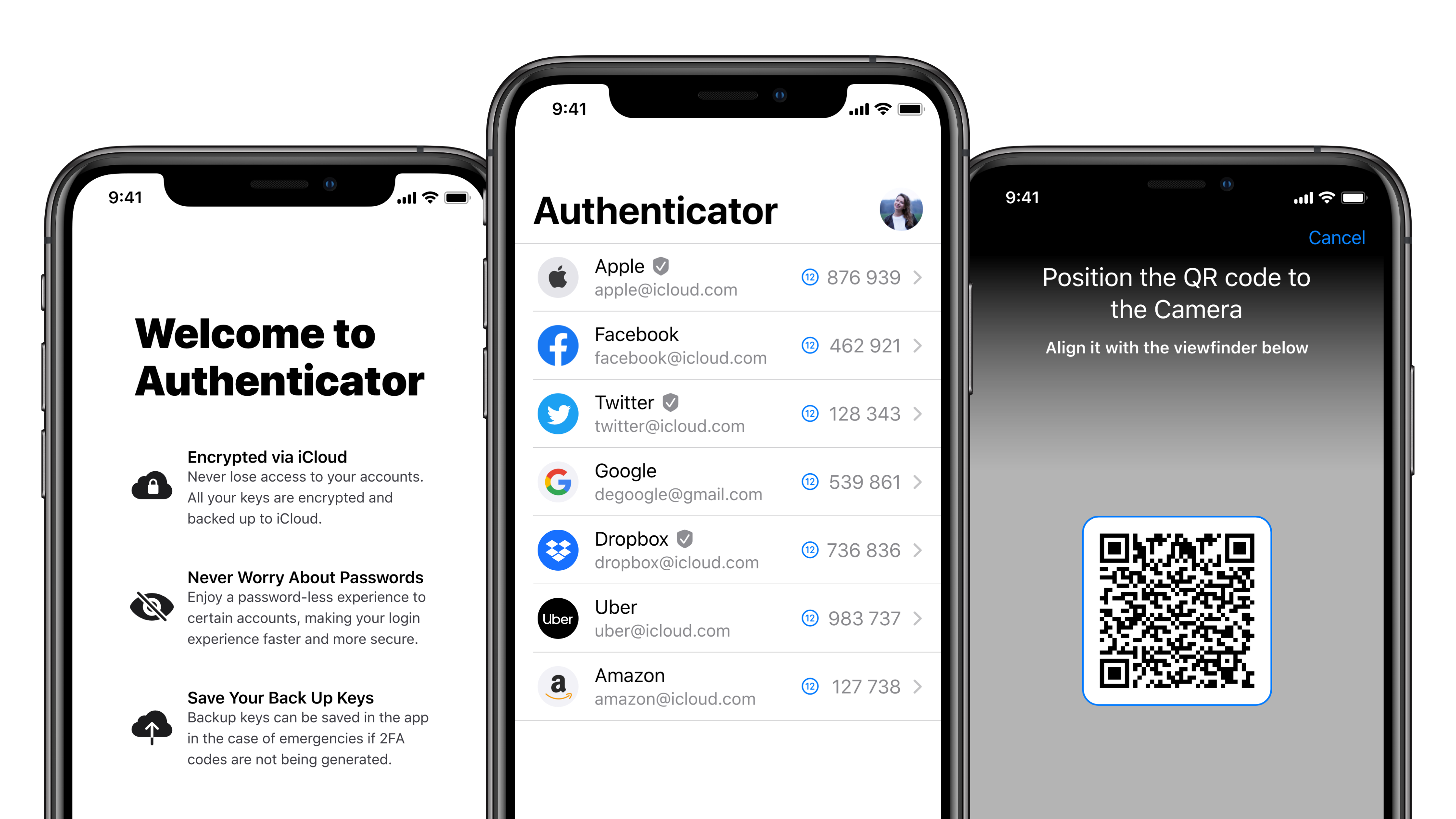
The new Apple Authenticator app would be a standalone app that comes pre-installed on every Apple device:

  • Manage, edit, delete and save backup codes in one place

  • Generate verification codes offline

  • Support for all services compatible with Google Authenticator

  • Seamless iCloud backup and sync

Introducing Apple Swift Login

A multi-factor authentication (MFA) solution that would be enabled automatically if a user has 2FA enabled and has an account with Sign in with Apple:

  • Users simply approve a login request by typing in their Apple ID

  • Verify identity via TouchID and/or FaceID instead of typing password

  • No need to receive and manually enter a six-digit code

This would require Apple to release an Authenticator API called AuthKit. By leveraging Apple's FaceID, TouchID and any other security mechanisms available, Apple and other companies can be 99.9% sure it's the actual account owner logging in.

Research

Primary Research - Instagram Polls

I asked my Instagram followers (mostly between ages 19-30) three questions:

Do you know what 2FA is?

Yes87%
No13%

85 responses

Do you have it enabled on personal accounts?

Yes60%
No40%

73 responses

Competitive Analysis

Google Authenticator

Google Authenticator

Microsoft Authenticator

Microsoft Authenticator

Authy

Authy

1Password

1Password

LastPass

LastPass

Duo

Duo

Key User Pain Points

Through secondary and primary research, I identified four key user pain points:

  • Lack of awareness — Users don't understand what 2FA is or why they need it

  • Inconvenience — Extra steps feel like friction rather than security

  • Lack of offline support — Many apps require internet connection

  • Poor user experience — Complicated interfaces and manual code entry

Persona

Based on my research, poll and competitive analysis, I came up with a persona of a user that would benefit the most from this app. Security affects every user, so I could have made hundreds of personas that would relate to this product, but I chose to do one for simplicity's sake.

User persona - Monica

Information Architecture

Having an information architecture diagram helped me understand the data users will see and how they can navigate through the app. Because of the simplicity and minimal number of actions, this diagram helped ensure all information was shown clearly and logically.

Loading diagram...

Apple Authenticator Information Architecture

Visual Design

I used Apple's iOS 13 Design Kit while adhering to Apple's Human Interface Guidelines to design high-fidelity wireframes. I studied all default iPhone apps to understand how to lay everything out in the most straightforward and user-friendly way.

Launch & Setup

Home screen with app icon
Onboarding screen

Adding Accounts

Users can add accounts via QR code scanning or manual code entry:

QR code scanner
Manual entry - empty
Manual entry - completed

Managing Accounts

Account list with reordering capability, edit screens, and backup code storage:

Account list
Edit mode
Account details

Approving Requests

Login request notifications with approve/deny interface and biometric verification:

Login notification
Expanded notification

Results & Learnings

7
User Tests
Conducted for validation
100%
Task Success
All testers completed flows
85
Poll Responses
Primary research participants

Sometimes the user doesn't know what they want until you show them

When my test group saw the Apple Swift Login feature, they fell in love with the idea of having a password-less login experience because of its fluidity, saved time and minimal effort.

Security became a priority through necessity

Apple has been working hard on focusing on privacy and security with features like password suggestions, two-factor authentication on Apple IDs and more. A few years after the celebrity iCloud photo leak during WWDC 2019, they introduced the "Sign in with Apple" feature.

An integrated solution is always the best option

While many 2FA apps meet the criteria of being useful, usable, and desirable, the one thing they all lack is the power of system integration. Apple could bring great benefit to the safety of its users on a massive scale by stepping in to solve this issue.

Design Philosophy

I used Apple's official iOS Design Kit with minimal design changes because I wanted to design an app that focused more on the user experience than the user interface. The main goal behind this app was to focus on its usability and value.

Archive

View Original Portfolio

This case study was rebuilt from the original 2019 portfolio. View the original PDF for the complete archive.

Download PDF

This was exploratory concept work created to demonstrate end-to-end product thinking and design process.

Other Work